
Content marketing – ‘the process of selling through content creation and sharing’. Once hailed as the surefire way to improve search rankings, to increase time on site, to boost sales and to multiply revenue. Yet now, marketers must think twice about how they implement these strategies because it seems every business out there is doing it. But what’s the point? What are the positives and negatives of content marketing, and does the concept go deeper than ‘the company blog’?
The rise and fall of ‘content’
In recent years, content has been proclaimed as the way to do online marketing. Marketers, CEOs, entrepreneurs, social media managers and agencies have invested vast amounts of time and money into creating *stuff* to promote themselves. The heart of the concept comes from its often indirect nature – bypassing the filters that consumers have put up to fend off attacks from direct marketing and adverts. Instead, it’s often not about selling a product, but about communicating trust in a brand, so that when the need arises, that brand is the go-to provider and problem solver.
It’s about patience – playing the long-game of giving away knowledge and experience for free, or rather, ‘for free’. Whilst much of this knowledge is shared on publicly viewable blogs (and, indeed, on social media), there is always a push for the next step; the tradeoff for receiving that next oh-so-enticing bit of content is the bargain price of your email address. Thus, the conversation is able to progress, and the dance goes on.
Not to burst your bubble…
Nevertheless, the undoubted successes that have come with marketing in this way have led to a content boom, making it increasingly difficult for any truly great content to stand out. We’re more or less at the point of self-defeat – the surge of content on the web created purely for promotion is preventing the right content being discovered by the right users.
Of course, marketers get smarter and invent software to help their *stuff* rise to the top: software which then becomes more accessible and affordable (and can be easily replicated) so that even more *stuff* can be put out there to compete with all the other *stuff*. And those that help to get your *stuff* to the top have to create *stuff* of their own to tell you how good they are at getting your *stuff* seen.
The cycle continues.
The Numbers Game
This (now dated) statistic from Buffer’s recent blog post ‘We’ve Lost Nearly Half Our Social Referral Traffic in the Last 12 Months‘ (which is a fantastic read, by the way) sums this all up quite nicely:
Consider the hundreds of thousands of quality blog posts that are published daily (on WordPress sites alone last year, the daily average was 1.5 million new posts). Then add in all the multimedia content: photos, videos, GIFs, and graphics to support the original posts.
And then add all the user-generated content as well. Status updates and personal pictures shared to social networks sit right alongside Buffer blog posts and BuzzFeed articles in your timeline.
This “content crush” means creating content – even well-promoted content – is no longer enough.
Why still so popular, then?
Everybody’s doing it
Beyond the obvious advantages to content marketing – the increased conversations and sales successes – I think perhaps there is a deeper reason for the success of the strategy. Everybody has jumped on board the content marketing trend because everybody already does it.
I’m not referring to the amount of people who ‘do Content Marketing.’ I’m thinking more broadly. Conscious or not, part of the human condition is to sell – and might I suggest, it’s not always a positive thing.
Whether we’re speaking about ourselves, our latest phone, the places we’ve been on holiday or our favourite restaurant, people sell. We describe, we embellish, we persuade! This is not seen any clearer than on social media.
Your own, personal shop window
Online profiles give us the opportunity to sell ourselves in a way we’ve not really had the previous opportunity to – ‘anonymously’. Social networks provide us with our own personal shopfront, and the product of the month is ‘me!’ Our profile is a channel of communicating who we are, just as we want people to see us, without the fear that we might be found out if our sales pitch isn’t entirely accurate.
Whilst the same could be said of writing letters to a pen-friend, never before have we been able to ‘share ourselves’ on such a scale, representing ourselves so often to so many people.
Through others’ eyes
We’re under constant pressure to present the best version of ourselves, particularly encouraged by the fact that everyone else is doing it! Alexia LaFata argues, social media makes us constantly re-evaluate the way we self-represent because it constantly pushes us to see ourselves through other people’s eyes.
To quote Alexia directly:
You cannot exist in this world without both a real-life version and an online version of yourself — and, sometimes, the two do not align.
In real life, we are all about finding ourselves; on social media, we are all about finding the version of ourselves that gets the most positive feedback.
Everything we do to further the story that is our online presence is done intentionally, to optimise our online image. This is so deeply ingrained we often do it without realising why.
Constantly performing for an audience of thousands is exhausting. Is what you post on social media the real you, or is it the you that you want others to see and react to? To me, it’s the latter.
Considering one step further, I propose this need to fight to influence others’ perception of us comes from our innate desire to tell and consume stories. I’m a firm believer that this is part of the human condition; we are fascinated by storytelling. I personally believe this is because we are made by a creative God who loves stories and places us within them. His salvation mission is told through the story of the Bible, creatively sharing information to us through a narrative medium.
So what…
Will it ever completely fail: will content marketing truly disappear? It would seem unlikely.
Like many things, marketing trends are cyclical. Even when the next big thing comes along, it’s fair to say it will at least contain some of the same core principles as what has gone before.
At the end of the day, content marketing is by no means dead – it’s just going to keep getting harder to see significant ROI without taking the time to do it well.
What does this look like in practice? If everybody is, on some level, optimising their content – the projected image of their corporate or personal ‘self’ – you better make sure you are too.
Put it this way; it would be a mistake to assume that content marketing will still lead to a sudden leap in traffic or sales with minimal effort.
Do it right
One of the biggest mistakes I see businesses make is they assume content marketing is a magic bullet. Effective content marketing takes time, but if you’re patient enough you will see a positive return on your investment.
Derek Miller
The Long Game: How to Drive and Convert Web Traffic
As the article from which the above quote was taken also advises, don’t neglect the planning stage and be sure to document your content marketing strategy. Doing so not only means you can be more efficient in your implementation but also means you can tweak the parts that work, and rethink the parts that don’t. Planning and replanning will save time in the long run and will – hopefully – bring about better results.
This feeds through to all areas of your communications output. Whether on your company blog, the copy on your website, or even in each social media post, think before you click ‘Submit’. Even better, think before you click ‘Add new post’. Does this content fit within our documented strategy? What purpose does it serve? Consider the motivation behind this update, this message, and then evaluate: Does this come across effectively?
Pro-tip; Ask a co-worker’s opinion, or perhaps leave it and come back to it with fresh eyes after an hour or two. This will help you to be more objective in your assessment of the post’s effectiveness.
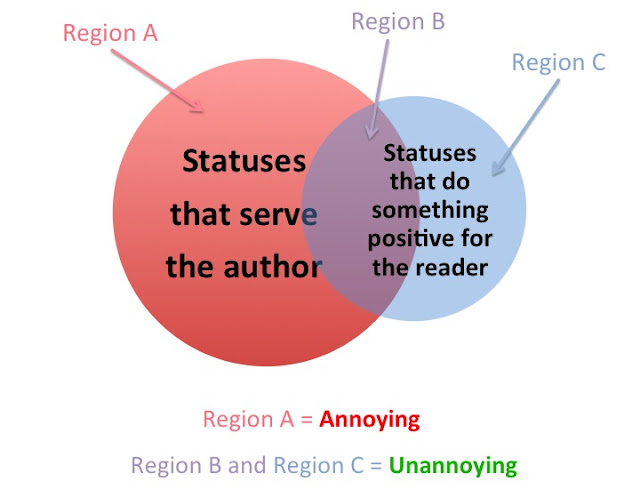
Remember the key rule of online posting – add value to others, as this infographic demonstrates, courtesy of Wait But Why:
Last but by no means least, value quality and clarity in your content. No matter how minuscule the update, aim to make it the best it can be and revisit your content often, to make sure it’s still the best! As with everything, this takes effort, and planning, but that extra thought might be the difference between a great piece of content, and another piece of *stuff*.